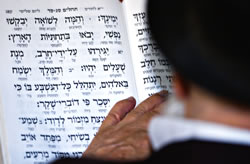
The canon of Scripture
The discerning heart seeks knowledge
~ Proverbs 15:14
The word Scripture conveys the idea of sacredness. When we talk of Scripture we mean the Christian Bible, and the divine authority of what we know as the Word of God. The Bible, in the original languages of Hebrew (and a few chapters in Aramaic) in the 39 books of the Old Testament, and in Greek, in the 27 books of the New Testament, is the first reference point for understanding the life of faith in Jesus Christ. The canon of Scripture means the accepted complete text of the Old and New Testament writings in the original languages.
The Bible tells us that the Law was written by Moses and that it was periodically read to the people [Deuteronomy 31:9-11,24-26].
Deuteronomy 31:9-11,24-26
So Moses wrote down this Law and gave it to the priests, the sons of Levi, who carried the ark of the covenant of the Lord, and to all the elders of Israel. Then Moses commanded them: “At the end of every seven years, in the year for cancelling debts, during the Feast of Tabernacles, when all Israel comes to appear before the Lord your God at the place He will choose, you shall read this Law before them in their hearing.”
After Moses finished writing in a book the words of this Law from beginning to end, he gave this command to the Levites who carried the ark of the covenant of the Lord: “Take this Book of the Law and place it beside the ark of the covenant of the Lord your God. There it will remain as a witness against you.”
×Other prophets also recorded the Word of God [1 Samuel 10:25; Isaiah 30:8; Jeremiah 36:2 and Zechariah 7:12; Daniel 9:2].
1 Samuel 10:25
Samuel explained to the people the regulations of the kingship. He wrote them down on a scroll and deposited it before the Lord ...
Isaiah 30:8
“Go now, write it on a tablet for them, inscribe it on a scroll, that for the days to come it may be an everlasting witness.”
Jeremiah 36:2
“Take a scroll and write on it all the words I have spoken to you concerning Israel, Judah and all the other nations from the time I began speaking to you in the reign of Josiah till now.”
×Zechariah 7:12
“They made their hearts as hard as flint and would not listen to the Law or to the words that the Lord Almighty had sent by His Spirit through the earlier prophets ...”
Daniel 9:2
“... in the first year of his reign, I, Daniel, understood from the Scriptures, according to the word of the Lord given to Jeremiah the prophet, that the desolation of Jerusalem would last seventy years.”
×The New Testament records that Jesus quoted from the Law, the Prophets and the Holy Writings, or, to use the Hebrew terms, the Torah, Neviim and Ketuvim. Jesus mentioned events like the destruction of Sodom and Gomorrah, Noah and the flood, Jonah and the whale. He referred to Adam and Eve, to Abraham, Moses, David, Elijah, Isaiah, Jeremiah and Daniel. Jesus showed His belief in the whole canon of Old Testament Scripture and His literal interpretation of it.
The Bible gives the unmistakable impression that by the time the New Testament was written (ca 40-90 AD) there was a fixed canon of Old Testament Scripture to which authoritative appeal could be made. Certain verses assume the existence of a complete and sacred collection of Jewish writings that were already marked off from other literature as separate and fixed. Jesus is recorded in John 10:35 as saying that “Scripture cannot be broken.”
From the time of the prophet Samuel, the Torah – the first five books of the Law of Moses – was considered authoritative. By the time of Jesus the Old Testament canon had been settled in the minds of Jews. Josephus, the Jewish historian, writing around 100 AD, also assumed that the Old Testament canon, as we know it, was fixed and settled.
New Testament
As in the case of the Tanach we cannot set a date upon which men decided the canon. What we can say is that by around 370 AD there was official recognition of the twenty-seven books of the New Testament.
The following principles were at work:
- Who was the writer?
Was the book written by an apostle or one who was closely associated with the apostles? [2 Peter 1:16; 2 Peter 3:15-16]
2 Peter 1:16
“We did not follow cleverly invented stories when we told you about the power and coming of our Lord Jesus Christ, but we were eyewitnesses of His majesty.”
2 Peter 3:15-16
“Bear in mind that our Lord’s patience means salvation, just as our dear brother Paul also wrote you with the wisdom that God gave him. He writes the same way in all his letters, speaking in them of these matters. His letters contain some things that are hard to understand, which ignorant and unstable people distort, as they do the other Scriptures, to their own destruction.”
× - Spiritual content.
Was the book read in the churches and did its contents spiritually edify?
- Doctrinal soundness
Were the contents of the book doctrinally sound? Any book containing heresy, or any teaching contrary to the already accepted canonical books, was rejected.
- Usage
Was the book universally recognized in the churches and was it widely quoted by the church leaders?
- Divine inspiration
Did it claim or give evidence of divine inspiration? This was the ultimate test.
Related messages: